
Digital Extension Services for Web3 (From the UK to the USA)

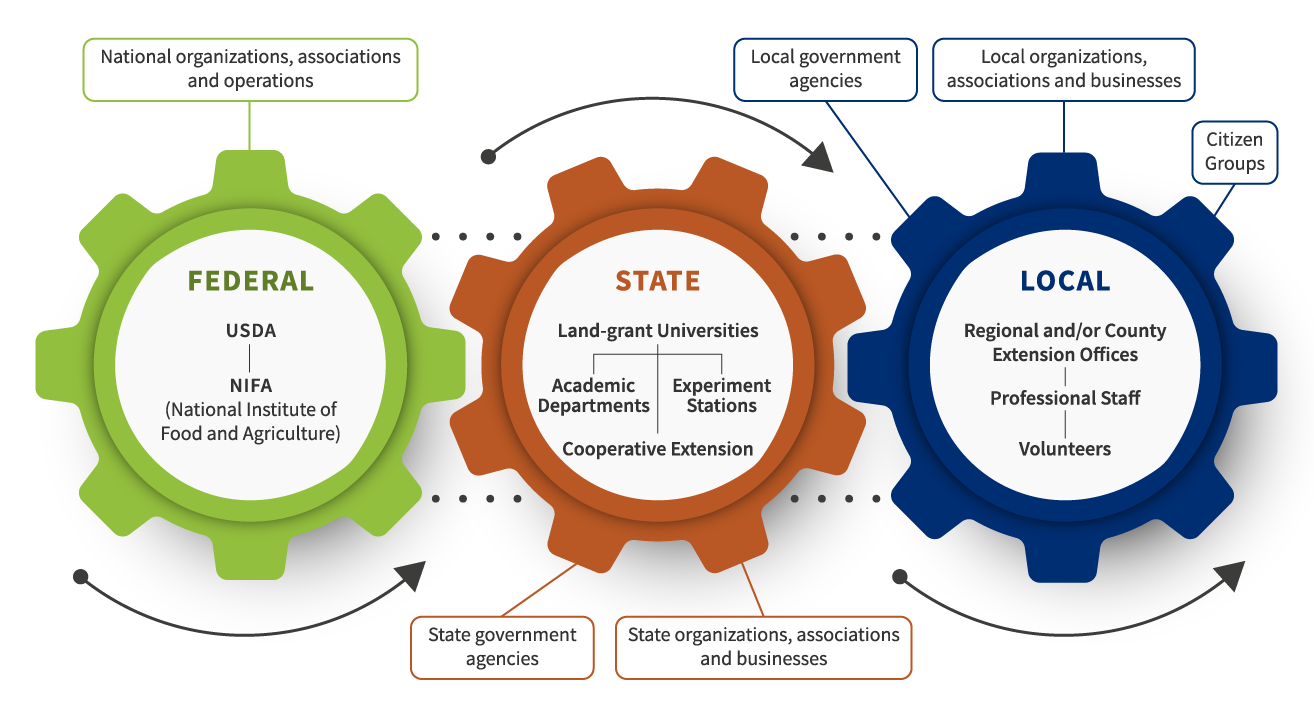
Source: National Institute of Food and Agriculture
Abstract
This paper traces the American reception of the university extension movement that began in nineteenth-century Britain, from its diffusion through the Lyceum and Chautauqua movements and the American Society for the Extension of University Teaching, founded in 1890, to its consolidation into the Cooperative Extension Service under the Smith-Lever Act of 1914. Read as a companion to the parallel UK to Canada history, the American case shows a distinct developmental trajectory. Educational extension was first practiced in the United States as a popular, largely non-university movement, while agricultural extension became the more durable institutional form, built on a federal-state-county partnership tied to the land-grant university system. The paper argues that this tripartite funding and governance structure, rather than the lecture format alone, is the most instructive American precedent for Web3 Extension Services (W3ES), since it demonstrates how decentralized, locally rooted knowledge transfer can be sustained at scale without collapsing into either pure centralization or pure informality. This history is intended primarily for Web3 builders and community organizers, digital literacy policymakers, and extension studies scholars, though it should also interest general readers curious about the history of public knowledge institutions.
Keywords
University Extension, Cooperative Extension, Land-Grant Universities, Morrill Act, Hatch Act, Smith-Lever Act, Chautauqua Movement, Web3, Small World Networks (SWN), Digital Literacy, Knowledge Democratization, Decentralized Identity, Community Empowerment
1. The Roots of Educational Extension: From the UK to the USA
The impulse to extension thinking predates the University of Cambridge’s 1873 lectures by decades. Lord Henry Brougham’s Society for the Diffusion of Useful Knowledge, active in Britain from 1826 to 1848, aimed to carry scholarly work beyond university walls to a general reading public. It stands as a direct precursor to the later extension movement.
As the companion paper to this one describes, the university extension movement began at Cambridge in 1873, when the university sanctioned the Local Lectures Syndicate founded by James Stuart, building on lectures Stuart had already been delivering since 1867 at the invitation of Anne Clough and the North of England Council for Promoting the Higher Education of Women. Oxford University followed in 1878. Word of these efforts crossed the Atlantic quickly, but it arrived in the United States by a different route than it did in Canada.
Where Canadian universities took up the British extension model directly and relatively early, the American reception passed first through a homegrown popular movement rather than through university departments. The American Lyceum, founded in 1826, was already circulating some of the same methods, bringing public lectures and adult learning circles to towns across the country, decades before anyone in the US used the word ‘extension.’ In 1874, the Chautauqua movement began at Lake Chautauqua, New York, founded by Methodist minister John Heyl Vincent and businessman Lewis Miller, initially as a summer training program for Sunday school teachers. It expanded almost immediately into a much broader vehicle for adult education, combining lecture courses, correspondence study, and reading circles, and by the 1880s it had become one of the most important popular education movements in American history. Millions of Americans, many in rural regions with no nearby university, encountered university level material for the first time through Chautauqua’s traveling circuits and correspondence courses.
It was only in 1890 that the British model was formally imported into an American university setting, when William Pepper, provost of the University of Pennsylvania, founded the American Society for the Extension of University Teaching, explicitly modeled on the Cambridge and Oxford system of local lecture centers. A National Congress on University Extension followed in 1891, and by the early twentieth century dozens of American universities, from Columbia to the University of California, had organized their own extension divisions.
The ‘Wisconsin Idea,’ formalized around 1904 under University of Wisconsin president Charles Van Hise, gave this movement its clearest institutional statement. It believed the boundaries of the university should be the boundaries of the state, and that the university’s expertise belonged as much to the public as to its enrolled students. Van Hise’s own thinking was shaped in part by the Chautauqua model, a reminder that in the American case, popular movement and university adoption ran side by side rather than one simply following the other, as tended to happen in Canada. By 1920, American extension theorist Bittner could observe that university extension in both the United States and Britain had become “a well-defined movement with elaborate institutional organization and fairly definite methods and objectives,” a sign the two versions, despite different starting points, had converged into recognizably similar institutions.
The educational extension movement in the US therefore has two lineages rather than one; a popular, voluntary lineage running through the Lyceum and Chautauqua movements, and a university-inspired lineage borrowed directly from Cambridge and Oxford through Pepper’s Society. But it was neither of these that became the most consequential and durable American extension institution. That distinction belongs to agriculture.
2. Carrying the University to the People: Land-Grant Universities and the Making of Cooperative Extension
If the story of educational extension in America is one of movements and societies, the story of agricultural extension is one of legislation. It has a clear beginning, a clear architecture, and a name that endures in nearly every US county to this day: Cooperative Extension.
The foundation was laid well before anyone used that term. The Morrill Act of 1862, signed by Abraham Lincoln in the middle of the Civil War, created the land-grant university system, granting each state federal land to endow at least one college with a mission of agricultural and technical education. The historian David Staley has called the Morrill Act arguably the greatest democratization of higher education in American history, since it was intended to place control of higher learning in the hands of the people rather than elites or religious denominations. Twenty-five years later, the Hatch Act of 1887 added a research layer to this system, funding agricultural experiment stations at land-grant universities so that the ‘science of farming’ could be studied systematically, rather than only passed down informally through farm help or in the family.
Much of the political will behind these acts came from organized farmers themselves, not only from legislators or universities. The National Grange, founded in 1867 as the Patrons of Husbandry, built a mass farmers’ movement explicitly framed in the language of extension, whose founding secretary Oliver Hudson Kelley wrote that he hoped “its extension should be as wide as the Continent.” The Grange’s lobbying for agricultural education and farmer-friendly research helped build the constituency that made the Hatch and Smith-Lever Acts politically possible, a reminder that American extension thinking was never simply handed down from above by universities to farmers but was also demanded from below by farmers themselves seeking knowledge and learning.
What was still missing was a mechanism for getting research out of the experimental stage and onto the farm. That mechanism was supplied by Seaman A. Knapp, a New York-born educator working for the US Department of Agriculture. Rather than relying on education through lectures, Knapp pioneered a method of teaching by demonstration. For this, he established a demonstration farm in Texas where he showed, in practice rather than in theory, how new cotton varieties and changed farming techniques could control the boll weevil and improve crop yields. Knapp’s key insight that farmers were more persuaded by seeing a neighboring farm succeed than by hearing a lecture theorizing about the possibility of success became the working method of American extension. This remains its defining pedagogical difference from the British lecture hall model that shaped Canadian and educational extension more broadly.
Knapp died in 1911. Three years later, Senator Hoke Smith of Georgia and Representative Frank Lever of South Carolina introduced legislation that fused Knapp’s demonstration method to the land-grant research base built by the Morrill and Hatch Acts. President Woodrow Wilson signed the Smith-Lever Act into law on May 8, 1914, creating the Cooperative Extension Service.
It’s ‘Cooperative,’ because the appropriation was structured as a shared partnership among the federal government, the state, and the county, each contributing funds and each holding a stake in outcomes. At the time the Act was signed, more than half of the American population lived in rural areas and nearly a third of the workforce farmed, which meant the Act’s reach was, by design, close to universal across rural America. The Act also completed the land-grant university’s enduring triadic mission of teaching, research, and service. Cooperative Extension supplied the service component that translated the other two into practice, later distilling into the system’s own current motto: “extending knowledge, changing lives.”
County extension agents translated university research into locally relevant practice, demonstrating the value of the Cooperative Extension Service almost immediately during the First World War.
3. Small World Networks, Land-Grant Universities, and the American Extension Model
As the companion paper’s use of Watts’ small world network (SWN) theory (1999) establishes, tightly knit local clusters are linked to wider systems through a comparatively small number of well-placed connectors. The companion paper’s view of small world networks (SWNs) applies to the American case with unusual precision because the American model made the small world bridge role into a formal, funded, and permanent position rather than merely a voluntary or occasional one as did the UK and Canada.
In the UK and Canada, the connector role was largely played by traveling lecturers and local extension committees, valuable but often informal, dependent on university enthusiasm and local volunteer effort. In the American cooperative extension model, that same bridging role was institutionalized as a salaried county agent embedded permanently within a specific local community and tied administratively both upward to the state land-grant university and further upward to the USDA. The county agent was, in the literal language of a SWN, the fixed connector node between the local cluster (the county’s farmers and families) and the broader distributed system (state and federal agricultural research). As the extension researcher McCormick observed in 1967, extension workers have long thought of themselves as ‘change agents,’ though he cautioned that to remain effective they had to stay inquirers as well as evangelists.
This is a meaningfully different design choice, and it is the one most worth carrying forward into any Web3 analogy. Lecture-based extension scales information more easily than trust. The Smith-Lever model addressed this by permanently funding locally embedded connector roles supported across multiple levels of government. And it solved for legitimacy by requiring three levels of government to co-invest, so that no single funder controlled the relationship between the university and the community it served. The result was and is a veritable SWN with an unusually resilient hub structure, one that in some US counties has now run continuously for well over a century.
These historical design principles invite a contemporary question: what might an equivalent connector architecture look like for decentralized digital technologies?
4. Web3 Extension Services: The American Design Principle
Historically, extension systems emerged whenever specialized knowledge outpaced the ability of ordinary citizens to apply it safely and effectively. While the technologies changed from industrial agriculture to public health to digital systems, the institutional challenge remained remarkably consistent: creating trusted intermediaries capable of translating expert knowledge into local capability while returning local experience, experimentation, and innovation back to researchers. Viewed in this broader historical context, Web3 represents another instance of this recurring pattern, rather than an entirely new problem.
The Canadian case for W3ES, as argued in the companion paper, rests mainly on the lecture and university outreach tradition, the idea that a decentralized technology needs its own version of a traveling lecturer, carrying literacy about consensus mechanisms, decentralized finance, self-sovereign identity, and decentralized governance out to communities that formal institutions have not yet reached. The American case suggests a second, complementary design principle to Canada’s and the UK’s versions, drawn not from the lecture hall but from the demonstration farm and the county office.
A mature W3ES would not simply teach blockchain concepts. Like historical extension systems, it would combine education, practical demonstration, trusted local mentorship, community feedback, and institutional coordination. Its objective would not be specific promotion or regulation of Web3 technologies, but the cultivation of informed public capability to evaluate, adopt, adapt, or reject decentralized technologies and communities of practice based on practical experiences.
The equivalent extension challenge today is not distance from a university. Instead, it’s distance from reliable internet access, secure digital tools, and the technical literacy needed to use them safely. A W3ES would therefore begin by addressing this gap.
Just as American farmers were persuaded more by working demonstration plots than lectures on soil science, Web3 adoption is likely to depend more on visible local demonstrations than on explanations alone. A W3ES should therefore prioritize functioning community applications over webinars, pamphlets, or abstract advocacy.
The distinction is subtle but important. Educational extension primarily persuades through explanation, while cooperative extension persuades through demonstration. Mature W3ES will almost certainly require both.
The core structural principle involves the tripartite funding and governance model created specifically in the USA. Sustained digital extension requires answering a question the Canadian model leaves open: who funds the connector, and to whom is the connector accountable once initial enthusiasm fades? Smith-Lever’s answer was shared funding and shared accountability across local, state (or provincial), and national institutions.
That architecture offers a template for W3ES that avoids two familiar modes of failure in digital literacy efforts: 1) capture by a single platform or funder, and 2) collapse once volunteer enthusiasm runs out. A W3ES agent modeled on the US county extension agent would be locally embedded, professionally trained, and structurally answerable to more than one level of the network they serve.
The agricultural economist Keith Griffin warned that extension systems naturally gravitate toward larger, lower-risk participants. W3ES therefore inherits not only Cooperative Extension’s strengths but also its equity challenge, requiring deliberate funding, training, and outreach to avoid reinforcing existing inequalities. As Jacob later argued, “the most profound Extension activity is to facilitate public deliberation,” a goal well suited to a mature W3ES.
Neither of these principles requires abandoning the lecture and literacy tradition described in the companion paper. Rather, they suggest that a complete W3ES model needs both halves of the Anglo-American extension tradition’s inheritance, the British and Canadian tradition of carrying knowledge to the people through teaching, and the American tradition of carrying knowledge to the people through demonstration, funded and governed as a durable, shared, local institution rather than a one-time outreach effort. Like experimental farms before them, W3ES should create experimental digital communities where governance models and decentralized applications can be tested safely before broader adoption.
Skepticism toward Web3, including volatility, scams, and regulatory uncertainty, strengthens rather than weakens the case for extension. A growing number of people already use wallets, self-custody tools, decentralized identity, and community governance with little support. Extension is therefore less a wager on Web3’s future than a response to its present reality, including both educational and practical needs.
The greatest barrier to Web3 adoption may be less technical than institutional. The challenge is not only building better decentralized technologies. It is also building trusted digital extension systems and ‘social machines’ (Sandstrom, 2021) that help people use them responsibly.
Although Web3 provides the contemporary case study, the broader question concerns how societies organize trusted public and private learning around emerging technologies.
Several concrete research questions follow from this history. Future research should compare alternative funding models, test demonstration-based approaches through community pilots, and examine how extension systems can avoid reinforcing existing inequalities and barriers. These topics point toward a broader conception of extension itself.
Extension thinking transforms knowledge into intelligence through repeated cycles of practice, observation, feedback, and improvement. Extension transforms research into practice and practice back into research through continual feedback. In this way it creates learning networks capable of both individual and collective adaptation. W3ES should pursue the same objective.
Whether W3ES ultimately emerges through platforms, universities, corporations, cooperatives, public institutions, DAOs, or hybrid organizations remains an open question. History suggests only that successful extension systems emerge through experimentation, local adaptation, and continual refinement. This paper therefore aims less to prescribe a final model than to recover a neglected tradition of public knowledge infrastructure.
5. Conclusion: Two Traditions, One Inheritance
The companion UK -> USA & Canada papers on “Digital Extension Services for Web3” together describe two complementary histories of extension thinking and action, both descending from the same nineteenth century British reform movement. Both traditions eventually crossed into North America, and both arrived at a similar underlying insight, that knowledge moves through networks that need trusted, durable, locally rooted connectors if they are to reach the people formal institutions leave out. The Canadian case shows what that connector looked like when built primarily around teaching and research. The American case shows what it looked like when focused primarily on demonstration and shared governance.
This paper does not argue that every Web3 technology will succeed, nor that existing extension institutions should simply be repurposed for blockchain. Rather, it argues that the historical problem of translating specialized knowledge into practical public capability has re-emerged in a new technological context deserving comparable institutional innovation.
A Web3 Extension Services model that draws on both traditions, rather than either alone, has the best claim to inheriting what made university and agricultural extension work in the first place, sustaining decentralized, locally rooted knowledge transfer without collapsing into either pure centralization or pure informality.
The lecture circuit, the county extension office, and the proposed W3ES illustrate a recurring institutional response to technological change: trusted local intermediaries that help individuals and communities translate specialized knowledge into practical capabilities.
Bibliography
1. Bittner, Walton S. (1920). The University Extension Movement. Bureau of Education Bulletin, 1919, No. 84. Washington, DC: Government Printing Office.
2. Graham School, University of Chicago (D.U.). “A Brief History of the Graham School: President Harper’s Vision.” https://graham.uchicago.edu/article/a-brief-history-of-the-graham-school-president-harpers-vision/
3. Griffin, Keith (1979). The Political Economy of Agrarian Change: An Essay on the Green Revolution. London: Macmillan.
4. Jacob, John S. (2013). “Experts, Extension, and Democracy: A Prospectus for a New Urban Grant.” Journal of Extension, 51(5), Article 11. https://doi.org/10.34068/joe.51.05.11
5. Kelley, Oliver Hudson (1875). Origin and Progress of the Order of the Patrons of Husbandry in the United States: A History from 1866 to 1873. Philadelphia: A. Wagenseller.
6. McCormick, Robert W. (1967). “A Basis for Change.” Journal of Extension. https://www.joe.org/joe/1967summer/1967-2-a6.pdf
7. National Institute of Food and Agriculture (NIFA), US Department of Agriculture (D.U.). “Cooperative Extension History.” https://www.nifa.usda.gov/about-nifa/what-we-do/extension/cooperative-extension-history
8. National Institute of Food and Agriculture (NIFA), US Department of Agriculture. “History.” https://www.nifa.usda.gov/about-nifa/who-we-are/history
9. Nevins, Allan (1962). The State Universities and Democracy. Urbana: University of Illinois Press.
10. Reber, Louis E. (1914). University Extension in the United States. Bureau of Education Bulletin, 1914, No. 19. Washington, DC: Government Printing Office.
11. Sandstrom, Gregory (2021). “Distributed Ledger Technologies and Social Machines: How to ‘smartify’ the economy with blockchain-based digital extension services?” Technology Innovation Management Review, 11(6): 42-57. http://doi.org/10.22215/timreview/1449
12. Sandstrom, Gregory (2019). “Is Blockchain an ‘Evolutionary’ or ‘Revolutionary’ Technology, and So What If It Is?: Digitally Extending Satoshi Nakamoto’s Distributed Ledger Innovation.” Social Epistemology Review and Reply Collective 8, no. 3: 17-49. https://social-epistemology.com/2019/03/07/is-blockchain-an-evolutionary-or-revolutionary-technology-and-so-what-if-it-is-gregory-sandstrom-part-one/
13. Smith-Lever Act of 1914, Public Law 63-95, 38 Stat. 372 (May 8, 1914).
14. Staley, David J. (2012). “Democratizing American Higher Education: The Legacy of the Morrill Land Grant Act.” Origins: Current Events in Historical Perspective, November. https://origins.osu.edu/article/democratizing-american-higher-education-legacy-morrill-land-grant-act
15. University of Oxford, Department for Continuing Education (D.U.). “19th Century Beginnings.” https://www.conted.ox.ac.uk/about/history/19thcenturybeginnings.php
16. Watts, Duncan J. (1999). Small Worlds: The Dynamics of Networks Between Order and Randomness. Princeton University Press.
17. Welch, Edwin (1973). The Peripatetic University: Cambridge Local Lectures 1873 to 1973. Cambridge: Cambridge University Press.
Attribution
This paper was assisted by AI (Claude + ChatGPT). It drew largely on research conducted, notes and quotations collected by Sandstrom from 2005-2017, updated with more recent thoughts, ideas and research, including the topic of Web3 and SWNs since 2017.